Get your products recommended in AI shopping answers
Buyers now ask AI which product to buy. StarRise scores every SKU in your catalog for AI readiness, shows which products make AI's top three and which miss, and enriches the listings so AI has a reason to pick yours.
AI recommends products it can describe
When a buyer asks for the best hiking boot under $150, the AI picks a few products and explains why. It can only explain what your listing tells it.
A product page with a two-line description and empty spec fields gives the engine nothing to compare. A competitor's page that lists weight, materials, certifications and use cases gives it a ready-made reason. Brand visibility tells you if AI names your company. Product visibility tells you which of your SKUs it actually recommends.
AI answer · example
What's the best lightweight daypack for day hikes?
- Pack A, 18L, 540 g, recycled nylon, with a rain cover.
- Pack B, 22L, hip belt and hydration sleeve.
- Your 20L daypack: not recommended. The listing has no weight, volume details or materials.
Every SKU scored on five AI readiness metrics
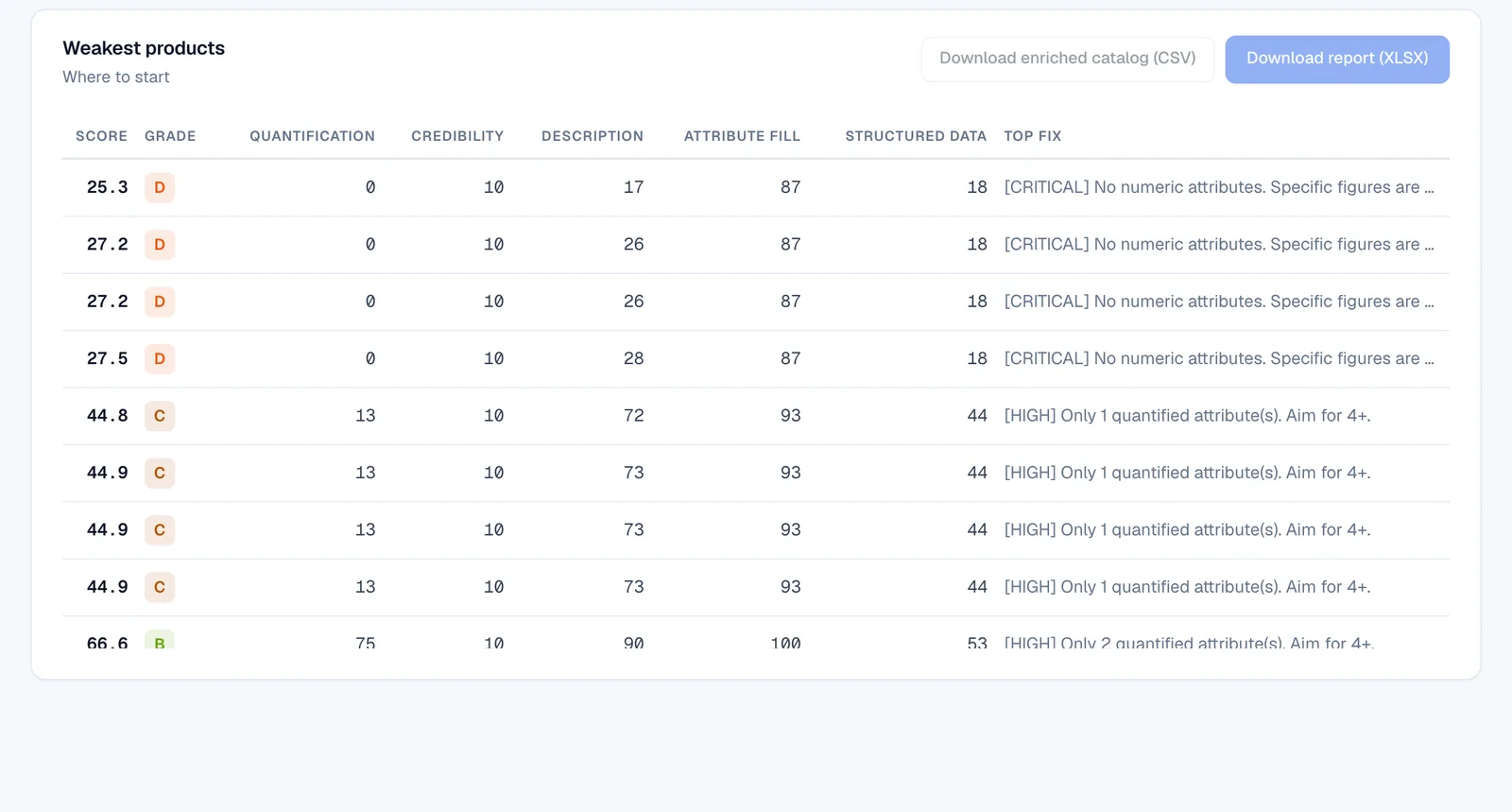
Each product gets a score from 0 to 100, a grade and priority flags, built from five things AI engines look for when they compare products.
Quantified specs
Real numbers on the listing: weight, size, capacity, battery life. Engines quote numbers when they compare.
Description richness
A description that says who the product is for, what it does well and when to use it.
Credibility signals
Certifications, standards, materials and brand facts that give an engine a reason to trust the claim.
Structured data
Attributes held in clear fields, so a machine can read them without guessing from prose.
Fill rate
How many of the attributes that matter for this category are filled in, and how many are blank.
Scored for what applies
A menu item and a power tool need different fields. Each product is scored on the attributes that fit its category, so a blank "battery life" never counts against a sandwich.
In AI's top three, or left out
The score tells you which listings are thin. A lineup test tells you what that costs you: StarRise puts each product next to comparable ones and records whether AI picks it for its top three.
Missed
Left out of the top three
AI compares the product with similar ones and leaves it out. Usually a thin listing with few specs. Start here.
Mixed
In some rounds, not others
AI picks the product in some rounds and passes it over in others, often because a rival listing gives clearer reasons.
Made it
In the top three
AI picks the product and explains why. Keep these listings current and use them as the model for the rest.
Catalog enrichment that gives AI a reason to choose you
For the products that need it, StarRise drafts richer attributes, descriptions, certifications and use cases, then re-scores each product so you see the before and after.
- Side by side: every changed field sits next to the original, so your team reviews before anything goes live.
- Flagged for review: each suggested value carries a confidence flag. Facts we couldn't confirm are marked for you to check.
- Your choice of scope: score the whole catalog, then enrich the lowest scorers or a set you pick.
- Ready to re-import: download the enriched catalog as a file you can load back into your store, plus a report of every change.
Illustrative example. Enriched values are suggestions until your team approves them.
Example · 23 → 74
Lightweight daypack, 20L
Before: A light, comfortable pack for everyday adventures. After: A 20-liter daypack for day hikes and travel, weighing 610 g.
- Recycled ripstop nylon
- Padded laptop sleeve, fits 15"
- Use cases: day hikes, commuting, carry-on
Proof AI now picks the enriched version
A better score is a means. The test is whether AI prefers the product. Before you publish, StarRise puts the original and enriched listings in front of an AI engine and records which one it recommends.
The order of the two listings is shuffled across rounds, so the engine can't just favor whichever it saw first. You get a win or loss per product and the content factors behind the result. These factors come from peer-reviewed research on what AI engines reward: statistics, cited sources, clear answers.
Projected is the plan. Measured is the proof.
Works with your catalog
Bring the catalog you already have. A product name is the only required field; extra columns pass through untouched. Not only for online stores: a restaurant menu, a clinic's treatments or a distributor's price list maps to the same structure.
- CSV or spreadsheet upload, with columns mapped for you and editable before the run
- Shopify and Amazon product exports, recognised automatically
Brand and product visibility, side by side
Product Visibility runs on the same platform as your brand tracking, so you see both on one dashboard.
| Topic | Brand Visibility | Product Visibility |
|---|---|---|
| The question | When AI recommends companies in our category, do we appear? | When buyers ask for the best product, do our SKUs get recommended? |
| Unit | Your brand, against your competitors | Each SKU in your catalog |
| Score | AI Readiness Score: brand visibility plus technical readiness | Five-metric AI readiness score per product |
| The fix | Ranked plan for your website and social channels | Enriched attributes and descriptions, ready to re-import |
| The proof | Re-run on the same questions and engines | Original vs enriched test, before you publish |
Product Visibility questions
How do I get my products to show up in AI shopping recommendations?
Give the engines facts they can compare. Fill in the specs that matter for your category, put real numbers on the listing, list certifications and materials, and say who the product is for. StarRise shows which SKUs are missing what, drafts the enriched fields, and tests whether AI prefers the result.
Will enrichment invent facts about my products?
Every suggested value is flagged by confidence, and anything we couldn't confirm is marked for review. Nothing changes in your store until your team approves it and re-imports the file.
Do I need to connect my store?
No. You can upload a CSV or spreadsheet export. A product name is the only required column, and StarRise suggests the column mapping for you to confirm.
How is this different from brand visibility?
Brand visibility asks whether AI names your company. Product visibility asks which of your products AI recommends, and why. A well-known brand can still have SKUs that never come up.
How long until AI recommends the enriched products?
Engines pick up changes as they re-read your pages, typically within a few weeks for your own site. We don't promise ranks or dates. We show the before and after so you can see what moved.